Rolling a Covered Call

I like to roll covered calls almost no matter what, even when my rolls are deep in the money. There are advantages to this strategy, particularly in bear markets.

When I sell options, my favorite management strategy is to roll the option out and collect a credit. I like to do this win, lose, or draw. With a covered call, I like to roll almost no matter what, even when my rolls are deep in the money. Over time, I’ve found there are some advantages to this strategy, particularly in bear markets.

If you read a lot of my explanations on selling calls, you’ll see that I have not been a big fan of call selling in general. That goes for call credit spreads, the wheel, and selling covered calls. My general complaint is that because the market goes up much more often than it goes down, short calls tend to lose money. I’ve seen it in my trading and I’ve seen it in back tests. But covered calls are one of the most popular trades out there- so why are there so many fans?

What is a covered call?

A covered call is a combination of buying or owning 100 shares of stock, and selling a call on that stock. Selling a call obligates the option seller to sell 100 shares of stock at the strike price of the option at any time the option buyer wants to exercise the option. Since the option seller owns 100 shares of stock, those shares cover the exercise risk of the call option- the call seller has 100 shares that can be sold if the the call buyer wants to exercise the option. But the option seller collects a premium when selling which decays in value over time. At option expiration, the option expires worthless if the stock is under the strike price, or it will likely be “called away” by the option buyer if the stock is greater than the strike price. Many traders sell calls against their stock positions to collect premium as extra income.

Let’s look at a typical set up of a covered call:

set up of a covered call
set up of a covered call with 42 days to expiration on a $200 stock

Here we are buying 100 shares of stock at $200 per share and selling a call with a strike price of $210 with 42 days to expiration (DTE). We collect a premium of $0.81, or a total of approximately $81 for the contract. So, our net cost per share to start is $199.19, instead of $200. This lowered “cost basis” is a benefit of selling a covered call- we’ll work to continually lower this further over time.

Throughout this article, we use this example position to demonstrate how rolling a covered call works. Each example transaction will be highlighted to differentiate it from the rest of the text.

To see how this strategy works, let’s look at a chart of the profit profile of each component plotted separately:
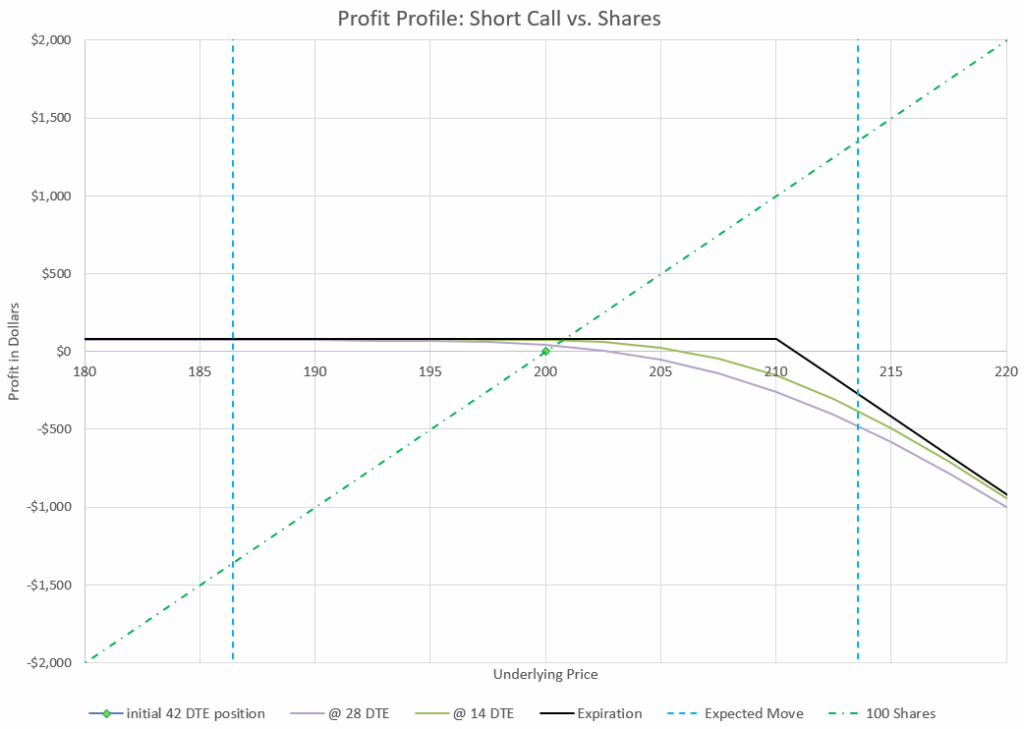
profit of a short call vs shares
profit of a short call vs shares- the two elements of a covered call strategy

The call makes a small profit at any outcome up to the 210 strike price, and the stock goes up and down. Above the 210 strike price, the two elements of the covered call go in opposite directions, cancelling each other out at expiration. Now, let’s combine the two profit lines into one and see what the outcome looks like:
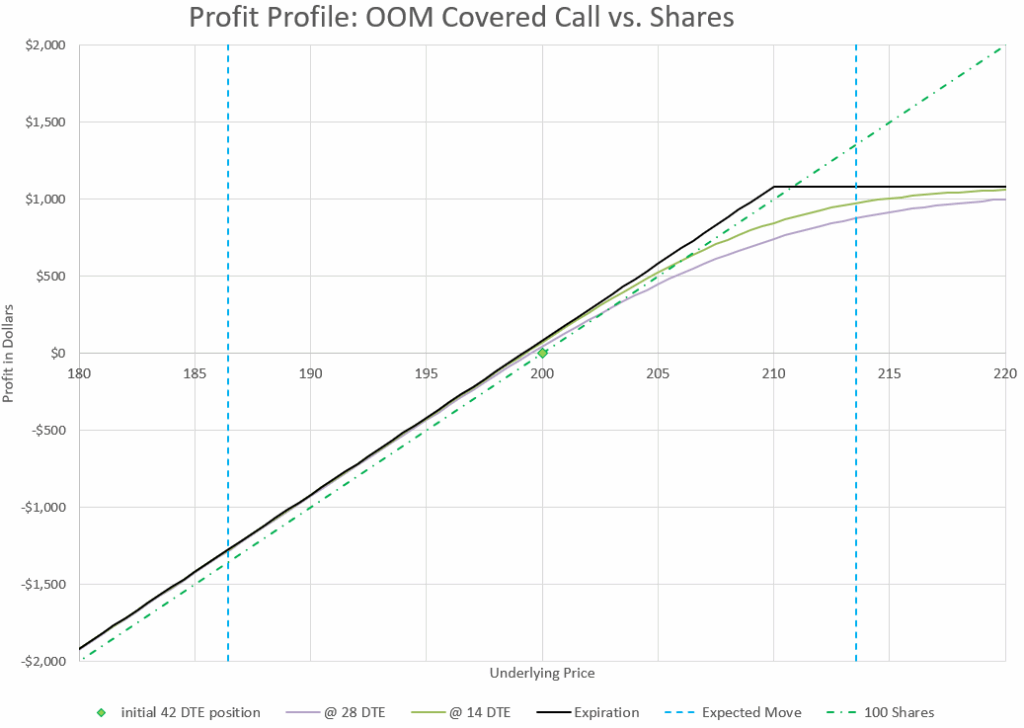
covered call profit profile
covered call profit profile- at expiration and at selected times before expiration

Through most of the expected move, the covered call profit is a little better than just owning stock alone. Recall that the expected move is what is implied by one standard deviation of the implied volatility of the option chain-see the article on expected moves for a refresher. Only as the price movement gets close to the upper range of the expected move will the covered call profit be less than stock alone. But even in that situation, the profit of the covered call is substantial. The covered call limits maximum profit in exchange for better outcomes at every other point in the profit curve below the strike price.

Ultimately, covered calls are bullish strategy- the long stock always has more positive Delta than the short call has negative Delta, so covered call owners make money when the stock price goes up.

There are several outcomes possible from selling a covered call. The only sure thing is that time is always on the side of the call seller, eating away at the extrinsic or time value of the call option. However, price movements in the underlying stock will move the total position up or down the same direction as the price movement. When price goes up, the stock obviously goes up, while the call option gets more negative premium. The option premium change counters the stock price change, but the stock move is always more than the option premium move. The same is true on down moves, the stock will always move down more than the option premium will help. In the end, the short call option dampens the response of the stock price movement either way. A covered call makes a stock holding less volatile- another benefit.

There are lots of ways to trade covered calls and to manage them. Some traders sell calls and then wait for them to expire or get exercised by the buyer. This is often true of “wheel” traders, who sell puts to get assigned shares, then sell calls against their shares until they the shares are called away, then they repeat the process, collecting option premium at each transaction.
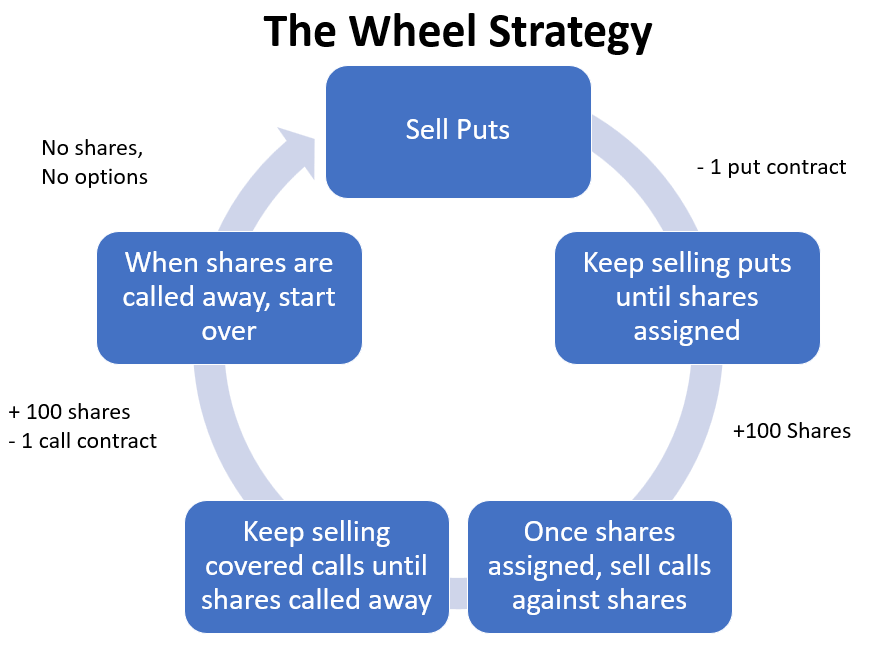
Wheel Strategy
The covered call is one element of the “wheel” strategy

Other covered call sellers aim to never let go of their shares and defend their positions so that the call buyer will never exercise the call option. This can be tricky, but the basic strategy is to make sure that the extrinsic value of the call is always more valuable than what the value of exercising the option is, so that exercising the option would be a money loser for the call owner. Generally, the three situations where a call buyer will exercise is when the option is in the money at or very near expiration, when a dividend is being paid, and when a stock option is too illiquid to sell and the only way to close the position is to exercise the call option. So, if a covered call seller can avoid being in those situations, they won’t lose their stock.

What does rolling an option mean?

Many new option traders are under the misunderstanding that they have to hold onto a position until expiration. If fact, generally a trader has three choices- hold, fold, or roll, which I’ve written about elsewhere. But let’s talk about rolling.

Rolling an option is when a trader closes one option and opens another option, usually in a single trade. A trader generally rolls up, down, out, or a combination. Rolling up means that the new option is a higher strike price than the old. Rolling down means that the new option is a lower strike price than the old. And rolling out means that the new option has a longer duration than the old.

As a continuation of our example, let’s say you have sold a $210 strike call on a stock and it is now set to expire in 28 days. You decide to roll out to 42 days. To do this you buy back the 28 DTE call and sell a 42 DTE call. If you sell a $210 strike call at 42 DTE, you have rolled out. If you sell a $211 strike call, you have rolled out and up.

Roll calls out
With price remaining at $200, we can collect a credit to roll out to 42 days.

In this example, we are again collecting 0.81 premium on our new call, and since the old call has decayed to 0.44 premium, we have made a profit of $37 in the 14 days we held this covered call position, even though the stock price hasn’t changed. As it happens, we also have collected a net $37 credit for our roll.

roll up and out
With the price up, we may want to roll up and out, while still collecting a credit.

In this next example, the stock is up from $200 to $201, so we decide to roll up to a 211 strike, which still allows us to collect an $18 credit. Since the stock went up $1 a share, we’ve made $100 on the stock and our call made $30, by decaying from 0.81 to 0.51. In total, we made $130 on the move, compared to only $100 if we had only had the 100 shares.

Some brokers may label these trades differently, perhaps considering rolling up or down as a vertical spread trade, since you are buying and selling an option in the same expiration. If you roll out, some brokers may label this trade as a calendar trade, since you are buying and selling the same strike at different expirations. And if you roll both out and either up or down, your broker may label the trade as a diagonal spread, since you are buying and selling options at both different strikes and different expirations. The true difference between these labels and a roll is that with a roll, one side of the trade is closing a position, while the other is opening a position. When rolling a covered call, you are buying to close the old position, and selling to open the new position.

Notice that when we roll, we are only transacting our call position. The stock stays untouched. The stock’s roll in this trade is to “cover” the short call, so that risk is managed, by limiting it to the cost of the stock.

Why Roll a Covered Call?

There are three good reasons that I think most people use for rolling a covered call. First, they don’t want to have their call option exercised, so they roll out for more time and more premium to make exercising the option by the buyer less attactive. Second, a covered call seller may roll because the premium has decayed and they want to have more premium to decay and the seller doesn’t want to wait for expiration. Third, a covered call may be in the money and a covered call seller may want more attractive strikes. All of these are valid reasons to roll a covered call. Ultimately, all of these reasons boil down to an overarching reason- to keep collecting call option premium.

For most covered call sellers, the goal is to collect additional income from selling calls, and to keep the income coming, one has to keep selling over and over, so rolling is a common way to do it. The only alternatives are to hold to expiration, or let the shares be called away. I prefer rolling to avoid surprises as expiration approaches and to avoid options being exercised against me as much as possible.

Easy Rolls vs Hard Rolls

If the price of the stock that you sold covered calls against never really moved, you could just roll out to the same strike time after time. Sometimes, this is the case, and decisions are easy. If stock prices stay in a range, regular rolls can collect additional premium without adjust strikes up or down. For me, I’m generally happy just rolling my strikes out when the Delta of my call is anywhere from 10 to 40. There’s plenty of premium to collect and I’m not in danger of having the call exercised.

The earlier rolls shown are examples of easy rolls- the price either stayed the same or went up a small amount where we could roll and collect a credit to have a new position with similar Delta and similar premium to what we started with before time passed.

However, if my Delta value gets higher or lower, I have some decisions to make.

Let’s start with Delta values that are less than 10. When call Deltas are low, that means the stock is getting low compared to the call’s strike price, probably because the stock is going down in value. That probably isn’t good because the stock can lose a lot more than the call decay can make for a covered call seller. The worst scenario for a covered call seller is for the stock to go down significantly in price. All risk is to the downside, and even though the call sale premium makes up some of the loss, it can be a drop in the bucket. So, what can a covered call seller do when the underlying stock goes down in price. Let’s consider three choices.

  1. Roll down and out. By rolling to a lower strike at a later expiration, a covered call seller gains premium both ways, more time and more Delta. Just pick the Delta you want from the later expiration and collect a nice payment for the roll. Sounds like a no-brainer. But what if the strike price is lower of the new option is lower than what you paid for stock? The concern is that if the price reverses, the position could get stuck in the money with a value less than what you paid. Do you want to potentially “lock in” a loss? For example, if you bought shares for $100 and the price drops to $80, is rolling calls down to $90 strikes a good plan? Many traders have a rule to never sell a covered call at a strike price less than their basis cost for their shares. If you sell covered calls over and over, all that premium effectively reduces your total cost for the position, so maybe $90 is still more than your basis, if you’ve collected a total of over $10 in premium. Maybe it’s a good idea or maybe not, depends on what got you to this point.
  2. Roll out in time. Even if the price has dropped a lot, a covered call seller should be able to roll out at the same strike price for a credit, even if it isn’t much. As you roll out, the Delta value will also go up. In fact the further you roll out, the higher the premium and the higher the Delta value, but within limits- the position is out of the money. The question is whether the premium collected is enough to give up potential gains if the stock comes roaring back. If you roll out, how far out? I generally don’t like to roll out very far if I’m not collecting very much, but for some traders this is an ideal situation, collecting a little premium with very little risk of having the stock called away. It’s all a manner of perspective.
  3. Stop selling calls on the stock for a while. I sometimes do this when the market is way down and it seems oversold. During big corrections or bear markets, I will let my calls either expire, or I may buy them back to close them when they have little value. In this case, I’m willing to wait a bit for the stock to make a comeback. If I’m not willing to wait, maybe I should close the out the stock position as well and put the money into something else. Sometimes, it is just time to cut losses and get out. But assuming that I want to keep the stock and I think it is just temporarily underpriced, I may choose to just hold the stock and not sell calls until the stock price is at a better value.

Which is the right choice? That’s up to each trader to decide. It also may depend on your view of the stock and the current market, as well as the stock’s cost basis. There are several factors to weigh, so there is no single answer for all situations.

To keep going with our earlier example, let’s say our stock declined from 201 to 195, so we decide to roll down and out.

roll down and out
With the stock price down, we decide to roll down and out and collect more premium.

We collect more net credit for this roll than earlier ones, because our old call strike is farther out of the money and IV has increased a bit. Our new Delta is quite a bit higher than where our old Delta has dropped to. We also make more on the call’s decrease in value from 0.69 to 0.15, a profit of $54. But, since our stock went down $6 a share, the stock lost $600. Our net change for the covered call is a loss of $546, so we lost less than if we held stock alone. So far, every example we’ve seen shows the call making our results better than if we had stock alone.

On the opposite side of the value scale, what does a trader do when the Delta value of the call gets high, or even gets in the money? This situation used to really frustrate me, because the covered calls probably have lost money when looking at the call alone. But, if you look at the underlying stock and the call, the total position is making money, even if the call ends up in the money. So, this is a better situation than when stock prices are falling and the short call is gaining. In fact, let’s instead think of this as a good problem to have. This time, let’s consider four ways to deal with this situation.

  1. Roll out and up for credit. If the stock has gone up, let’s try to move our strike price of our call up as well. The problem is that it can be hard to collect a net credit because higher strike options are not as expensive as a lower strike. So, to collect a credit, we may need to go further out in time to find an option at a higher strike price that also has more premium than the current option that is being replaced. As calls get into the money, the deeper in the money they are, the harder it becomes to roll up for a credit. And the further out a call is rolled in time, the harder the next roll is to roll up and out for a credit. That doesn’t mean that you shouldn’t do it, it just means that it is more difficult.
  2. Roll up and out for a debit. If a trader doesn’t want covered call strikes in the money and a position is in the money or close to it, the position can be rolled up to a higher strike, but it may cost more to buy the old option than the new option sells for, so the trader has to pay for the move. This is the opposite of collecting income from the stock, but remember that the stock has gone up a lot to get the call option into this situation, so in the big picture, the position is still winning. Perhaps the covered call seller just wants to make sure the stock won’t be called away, so rolling up is more important than collecting a credit.
  3. Roll out at the same strike. You can almost always collect a net credit by rolling a call out in time at the same strike price, whether the strike is in the money or not. This can be a good choice when none of the other choices seem appealing, and you just want to “kick the can down the road” as people sometimes say. The beauty is that you get paid to just wait a little longer. Sometimes, the additional premium of a later expiration is enough to make exercise un-economic for the option buyer on the other side.
  4. Let the stock get called away. Maybe the call you’ve sold is way in the money and you just don’t want to mess with it any more. If you let the option approach expiration, chances increase that an option buyer will exercise the option and your shares will be sold at the strike price of your option. Or you could sell your shares and buy the option yourself if you don’t want to wait for the option market to take out your position. In any case, the price you get is essentially determined- the strike price of the option is what you will get for your position. The advantage of the market exercising the option is that you don’t have to pay for your option to close it, so any extrinsic value plus commissions to close are saved. The reason to do this may be that you have decided that it is time to use your capital for something else. Maybe you’ve been holding onto the position to wait for it to be a long term capital gain and once it is there, it is a good time to cash out and do something else. If you are selling at a price more than you paid, it is a win regardless of how you got there.

So, what is the best choice? It depends on lots of things, but my preference is to find a way to roll up and out for credit as often as possible and roll out if there isn’t a good choice for rolling up. I generally avoid rolling up for a debit, but for some that may be a good choice. And when I’m ready to move on, I’ll let the market call my shares away. So there’s a time for each choice, and every trader needs to be aware of the various choices available to make the right decision for each situation they may be in.

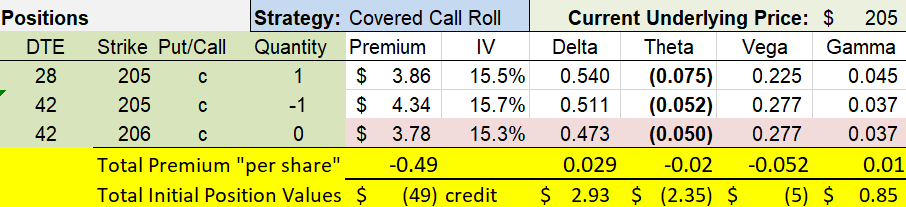
Continuing with our example, let’s say our stock has moved from $195 to $205 in 14 days. That means our stock is equal to the strike price of our call option. We may decide to again roll to 42 DTE, but keep our same strike price.
roll out call ATM
Since we can’t roll up for a credit at 42 DTE, we keep the same strike and collect a credit.

In the table above, I’m showing the choice I made, along with another possible choice that I decided not to make. I could have rolled up to the 206 strike, but it would have been a debit with the 206 strike having less premium than the older 205 strike. I could have rolled out further in time to get a credit to roll up as well, but here I chose not to.

If you recall, we opened this 205 strike position at 1.03 premium when the stock was $195, so we’ve lost $281 on the call. But since the stock is up $10 a share, it has gained $1000 in value, so our net profit on the trade is $719. We could have made more this time, with stock alone, but we are still making almost as much on a fairly large up move in the stock.

Are Deep In-the-Money Covered Calls Bad?

I used to feel like I had lost when I had a stock that I sold covered calls on blow past my strikes. I was obsessed with the fact that I would have been in a better position if I had just left the stock alone and let it go up in value. To some extent, this can be very frustrating. For example, if I bought a stock for $100 and sold $125 calls against the shares, and the stock goes up to $300, I’ve missed out on a lot of gains. But, on the flip side, I’ve made the difference between the purchase price and the strike price, plus I’ve collected premium from each call sale. WE don’t have to have extreme situations to find positive ways to manage our in the money option with a roll.

Continuing our example, let’s say that our stock price jumps up to $215 from our previous $205 price, and now our 205 call strike is getting deeper in the money. Now, we decide to add time to try to roll up just a little.

rolling up ITM
to roll up to 206 for a credit, I had to roll out to 63 DTE.

As we get deeper into the money, it gets harder to collect a credit when rolling up, so we may need to roll a lot further out in time. In this example, I went out to 63 DTE instead of the 42 DTE I’d used in all the previous example rolls. But I gained $1 on the strike and still received a credit.

On this transaction, we started by selling a 205 call for 4.34, and we had to buy it back for 11.42, so a loss of $708. Meanwhile, our stock went up another $10 per share for a $1000 profit. Our net profit on the covered call position was $292. And don’t forget that in this latest roll for a credit, we sold a call for 11.45 that is $9 in the money, so we have $2.45 extrinsic value going forward.

For situations that aren’t so extreme, I often like to think about multiple streams of income and side benefits from having and rolling a covered call that is significantly in the money. Let’s start with income and then talk about benefits.

Income stream 1: Call premium. Even when we roll a call deep in the money, there is still some premium to collect. There is more extrinsic value for more time. Each roll may be a small percentage, but it will likely be more than the going interest rate, usually substantially more.

With every example we’ve looked at, we’ve collected a credit, selling our new option for more than we paid to close our old option out for.

Income stream 2: Lock in strike increase profits. Every time a trader can roll up a call option that is in the money, they are locking in that much more profit. For example, if you own a $200 stock with a $150 strike covered call, if you can roll up the call to $155, you’ll lock in $5 more profit on the underlying stock if/when you sell the position. Since we are talking about 100 shares, that’s $500 more value. I look for opportunities to roll up my strikes, even if that means going far out in time to collect a net credit. Sometimes, I’ll just set a good to cancel limit order to roll up to the next strike in the next expiration at an even trade- my goal is to just ratchet up my strike price and eventual sales price of my stock.

In our last example, this was exactly what we did. We moved our strike price up $1, so if we decide to close this trade, our option has $100 less intrinsic value and the stock would sell in an exercise for $100 more than with the lower strike.

Income stream 3: Dividends. If the stock or ETF you own pays dividends, this can be a huge benefit of the covered call position and a significant source of income. Additionally, keeping the shares over a long haul can make the dividends be considered qualified dividends from a tax standpoint as mentioned earlier, so keeping the shares can be doubly important for tax reasons.

But with dividends comes additional exercise risk. The bigger the dividend, the greater the extrinsic value of the option you need to have to avoid having the shares called away when a dividend is being paid. This may be a driving force for paying a debit to roll up strikes to an option with more extrinsic value.

Dividends on stocks with covered calls are kind of like double dipping for many traders. This is a primary income strategy for many option traders.

Back to our example. Remember that we had $2.45 extrinsic value? If our stock paid a $1 dividend after our last roll, do you think we would have had our stock called away? Probably not, because an option buyer is unlikely to pay $2.45 extra to collect a $1 dividend. Rolling out further in time gave us that benefit as well. We make $100 dividend just like a stock owner with no calls sold against the position.

Let’s switch to looking at the benefits we still have when a covered call is deep in the money.

Benefit 1: Downside protection. When you have a covered call where the call is deep in the money, a down move in the price of the stock will have little impact. As long as the stock price stays above your call price, the expiration value of your position doesn’t change. So, while you may have missed out on a big gain, you can take a big down move of the market without a big loss to your account.

I know several covered call sellers that intentionally sell calls in the money for this reason, to greatly reduce downside risk. They give up big upside gains to have lower returns but a big buffer from down moves.

Let’s say our stock drops from its high price of $215 to $210 as our call winds down towards 28 DTE. Our 206 strike call has gone down in value from $11.45 in premium to $6.54.

roll up and out ITM
Since we aren’t as deep in the money, we can roll up by only going out to 49 DTE this time. We are still collecting a credit.

In this scenario, I chose to roll out an extra week so that I could also roll up another dollar in my strike price. But the big take away is what happened with my profit and loss of my position. My call made $4.91 while my stock dropped $5 per share, so my net loss was only $9, while owning stock alone would have been a $500 loss. The call almost completely bailed out my loss because it was fairly deep in the money.

Benefit 2: Lower overall volatility. Along with downside protection, a covered call position deep in the money doesn’t change much in value when the market goes up or down. It can be a portfolio stabilizer. The value of the stock and the intrinsic value of the option cancel each other out as the stock goes up and down in value. Only the extrinsic option value changes.

We can use Delta to see how this works. Let’s say we have a call with a Delta value of 80 sold against 100 shares of stock. Using our Delta math, we can see that the total position has a 100-80=20 Delta value, or represents only 20 shares worth of stock price movement when stock prices change. Said another way, for every dollar the underlying stock moves, our covered call position will only move 20 cents per share. For many traders, this is a very comforting position to be in.

If we chart our positions from all of our example trades, assuming that they we one after another, we can see that the covered call position is much less volatile than a comparison version of 100 shares of stock.
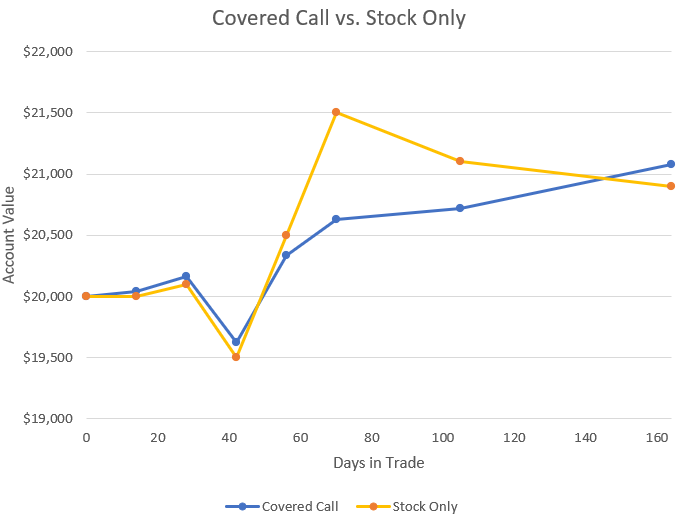
Position changes
The covered call position, especially when in the money has much less volatile changes with prices.

Benefit 3: Tax considerations. If the stock is going up, and the stock owner holds over a year in a taxable account, the gains are long-term gains and taxed at a lower rate. Meanwhile if calls have been sold against the stock while the stock went up, the calls likely have lost money, but the losses are short term losses, which cancel out premium collected, and may be used to cancel out short term gains elsewhere in the account. So, as part of a process to minimize short-term taxable gains and maximize long-term gains, maintaining covered calls in the money can help give traders tools to manage when taxes come due and how much the bill will be.

If the underlying stock pays dividends, in the money calls may allow the stock owner to maintain long term holdings and collect qualified dividends, which may be taxed at a lower rate as well.

These potential benefits are in taxable accounts only. Consult with your tax accountant or do your own study for your particular situation. This isn’t intended to be tax advice.

To finish our example, let’s say I decided to let the option expire in the money and have my stock called away. At expiration, the stock dropped from $210 down to $208. I kept my $661 of premium from the option sale, but had to sell the stock at $207, a dollar a share less than the current price. So, from my last roll until having my stock called away, I lost $300 on the stock from $210 to the $207 sales price, but made the $661 in option premium for a net profit of $361. Meanwhile, a stock only position lost $200.

Benefit 4: Basis cost reduction. Many covered call traders look at the premium collected as a reduction in the cost basis of the stock. Each extra chunk of premium means that the total net price paid for the combination of stock and call options goes down just a little.

I know traders that have traded covered calls on a stock position that their total cost basis has gone to zero and then negative. At that point, they feel like they are playing with “house money.” From a practical standpoint, getting enough premium to pay for the stock would likely take many years, so I consider it more of a mindset than a true goal.

Many covered call traders refuse to sell calls at strikes less than their cost basis, but if they have used call sales to reduce their position’s total cost, they are willing to consider the revised lower basis as a lower limit instead of what they paid for the actual stock.

If we at all the example trades together, we see that the covered call position cost basis ended up a $19,717, while we paid $20,000 for the stock. In addition to the stock, we have accumulated $383 in cash by the last trade, including the $100 dividend. Considering that the stock mostly went up, getting a cost basis reduction is a nice benefit. Here’s a log for reference:
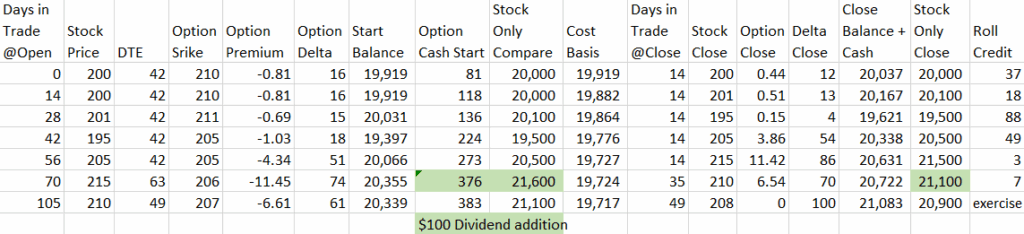
covered call trade log
Here’s a list of all of our example covered call roll trades for reference
Position changes
The covered call position, especially when in the money has much less volatile changes with prices.

If we take all these example trades together, we see that the covered call position ended up beating the stock only position, even though the stock went up 4% during the time of the trade.

Will selling covered calls against a stock always beat just holding stock alone? No, if a stock goes up significantly, the calls will be deep in the money, and the profit will be capped to a small trickle of option premium coming in from challenging rolls for credit. But even then, there are advantages to having sold a covered call and continually rolling. Just don’t beat yourself up over what might have been.

These example trades went through several changing scenarios- out of the money, in the money, up trends, down trends. In reality, a covered call position can stay in one of these scenarios for extended periods. It can be a pretty boring trade. But in options, boring is often a good thing. When an option gets deep in the money, rolls get more challenging as we’ve seen, but there is still money to be made, and premium to decay.

Worst case scenario

As an option trader, it is tempting to think of a short call option of a covered call position going deep into the money as a bad thing, even a worst case scenario. But, this isn’t that bad- the overall position is still making money because the stock is going up at least a dollar for every dollar the option loses. The real worst case scenario is when the stock drops significantly. When the stock portion of a covered call drops 10, 20, or maybe 50 percent, there is nothing that a short call can do to cushion the blow. The call can potentially save a few percentage points of the loss, but it can’t protect it all, or even come close. In the end, a covered call still has significant downside risk.

Is there anything we can do to get rid of downside risk using a covered call? While we can’t eliminate all the risk, there are a few ways to consider using covered calls to reduce big losses over time.

First, as we’ve discussed, selling covered calls reduces our cost basis with every roll we do for credit. The more credit we collect, the more of a downturn the position can sustain and still be profitable over the life of the trade.

Second, we can choose to sell our calls in the money to start with to protect a portion of the downside. I know traders that do this as a standard practice. Here’s an example from Brian Terry’s interview on ThetaProfits. In the money covered call sellers know that there will not be a large profit, as the in the money call caps the upside, but the call protects a significant move down, making the position very stable in value in all but the most extreme conditions. For example, if we sold a call with a strike price 10% in the money, we’d have 10% downside protection. As a practical consideration, we’d likely have to sell this call well out in time to have enough extrinsic value to have any time decay, but there is that possibility so we can still make money from premium decay.

Covered Call Conclusions

Rolling covered calls provide many opportunities for profits and additional benefits. Reduced volatility and additional income top the list. In virtually every market scenario there are ways to keep rolling and keep collecting net credits from option premium and get the benefits of time decay.

Beware of the trap of worrying about losing money on calls that go deep in the money, but be more concerned with the true risk of losing money from stock price declines. With the right mindset, rolling covered calls can be a great way to benefit your portfolio.
Is the Covered Call a Good Trade?

The Covered Call can be done in almost any account, requires no extra capital if you own 100 shares of stock, potentially increases portfolio income, and reduces volatility of returns.

Most discussions of options start with the Covered Call. The Covered Call can be done in almost any account, requires no extra capital if you own 100 shares of stock, potentially increases portfolio income, and reduces volatility of returns. What is not to like?

What is a covered call?

For those not familiar, a covered call is a trade where the owner of stock, sells a call for that same stock. This can also be done with exchange traded fund (EFT) shares. The risk of selling the call is “covered” by the shares that option owner has. The worst thing that can happen to the call position is that the stock price goes up and the call is exercised and the shares are “called” away.

Let’s look at an example. Say we own 100 shares of a stock currently trading for $400 per share. We can sell a call with a strike price of $420 expiring in 6 weeks or 42 days for a premium of $2.00, and collect $200 (1 contract is 100 share times the premium). By selling a call, we agree to sell our 100 shares for $420 any time in the next 6 weeks if a call buyer exercises the option. We don’t have a say in it, only the buyer does. But, if it happens, we also keep the $2.00 premium we just collected, so the total profit would be $22 over the current $400 share price, a 5.5% gain in 6 weeks or less. More likely, the call option will expire worthless if we don’t do anything and we keep the $2.00 premium and the 100 shares. That’s the proposition, and the potential outcomes from holding until expiration. And most people who discuss selling covered calls end the discussion with that, but this site is written for data-driven option traders, so let’s dig in deeper.

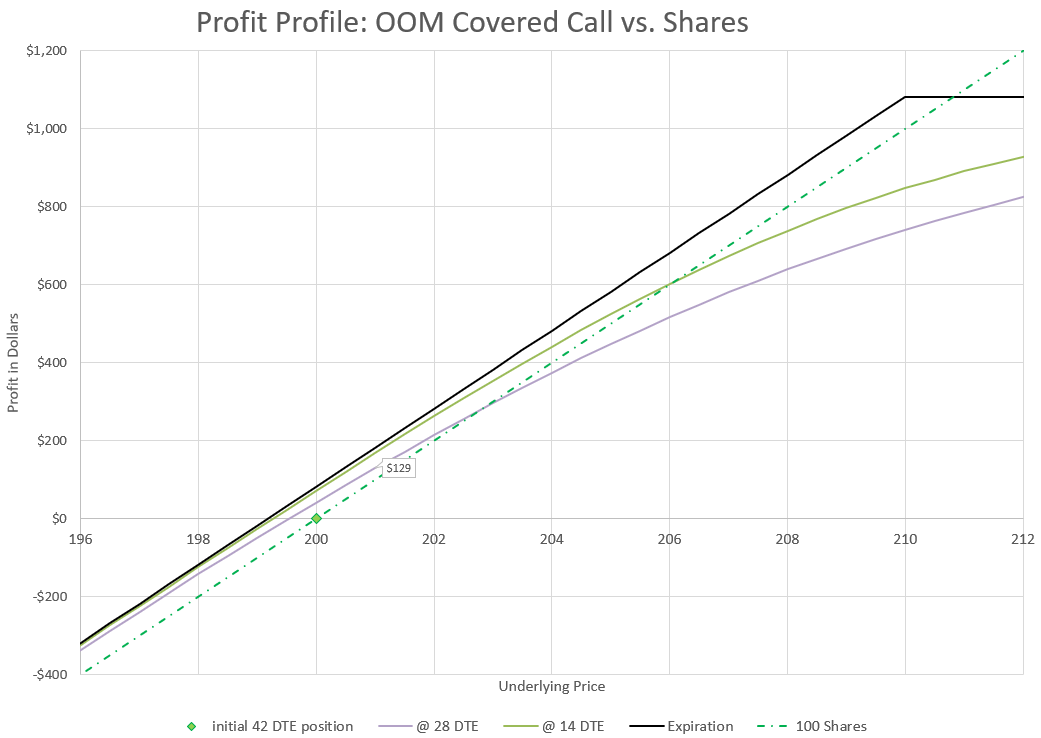
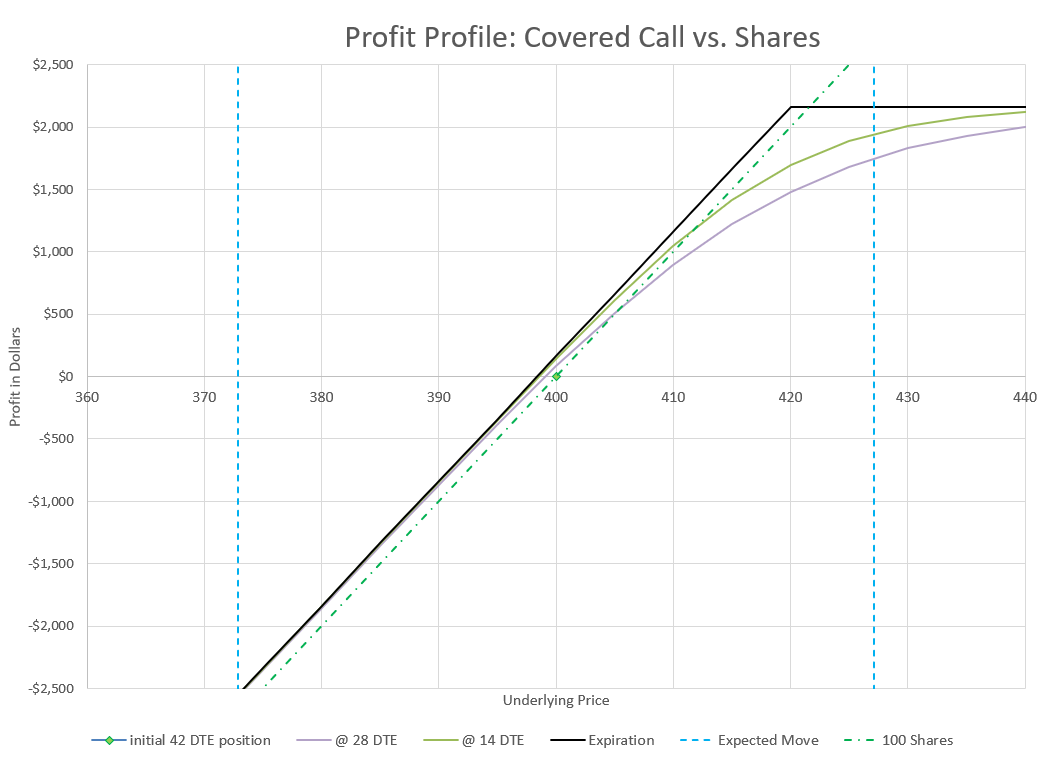
Below is a profit chart showing the profit profile at different points in time. One thing to notice is that the all the lines near the current price see to be close to parallel, or tracking with the expiration profit and the profit from just holding 100 shares alone. Those two lines are parallel, with the difference being the $200 that was collected when the call was sold.

However, if we look closely the lines representing the value at 28 days and 21 days aren’t quite as steep. This is because the time value varies significantly over different underlying prices. Initially, the Delta of the call being sold is 0.20, signifying that its value will change by 0.20 for every dollar the underlying stock changes in price, and meaning there is a 20% chance it will expire in the money. I find it easier to think of the our Deltas in whole numbers representing 100 shares, so our 20 Delta calls that we sold combine with the 100 Delta of the underlying shares to give us a net Delta of 80. So initially, our total position is going to move up or down $80 for each dollar in price that our stock changes. That means our position is only 80% as volatile as owning stock outright.

Covered calls improve the probability of profit over owning stock alone in exchange for giving up unlimited upside.

Another thing to notice is that even after a few weeks, the position has a profit even in a small $1 decline in stock price and is ahead of stock alone for the first several dollars in price increase compared to owning stock outright. So, if the price doesn’t move much, we have a profit and a better profit than owning stock. This is a nice outcome when the market doesn’t move.

A big move down is still a big move down for our total position, we just lose $200 less than we would have if we hadn’t sold the call which is only a small consolation if the stock drops 10 or 20 percent. As the market goes up, the position makes money, but we have an upper limit based on the strike price of the call. A quick move up increases the Delta of the call and keeps the overall position value well away from the expiration value until we get to expiration. So, at big moves, we have virtually unlimited risk to the downside and limited profit to the upside, which seems a bit backward.

If you sell covered calls much, you’ll have a number of situations arise of extreme moves in one direction or the other that can be very frustrating. This situation really turned me off from this strategy for a long time until I focused into probabilities more and worked out my management strategies. Before we get into those, let’s break this trade apart to see how each component behaves individually and see how that might make you think twice about the strategy.

Profit of selling a call or owning shares against different price moves up to expiration.
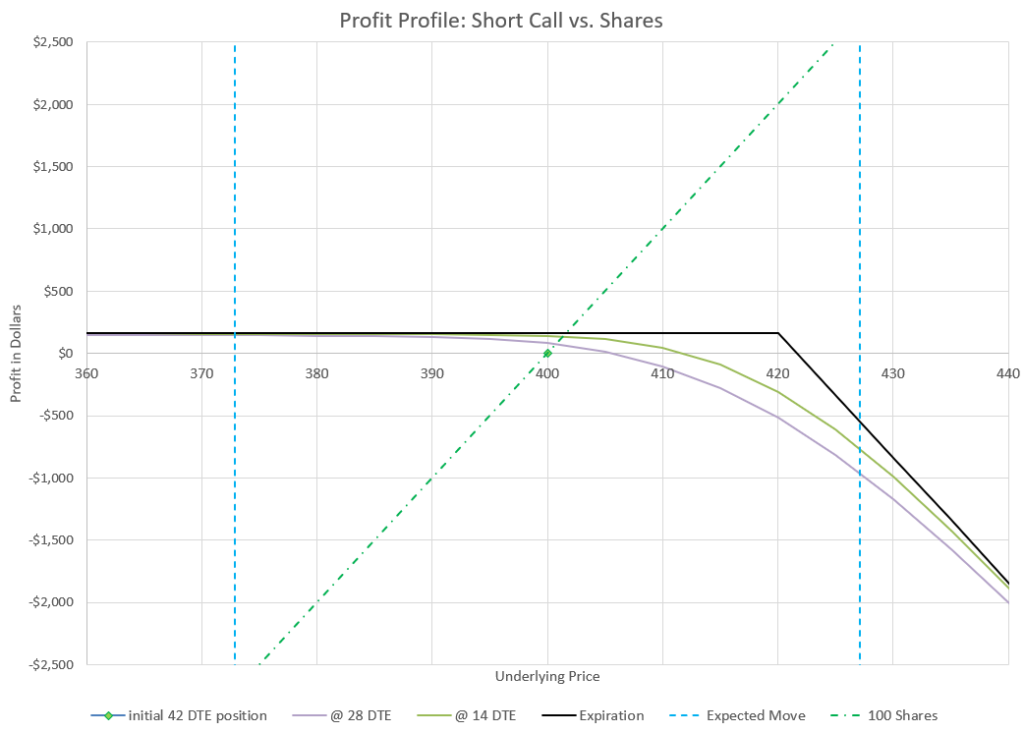
Here we see the profit profile at different prices and times for just the call that is sold and the underlying shares.

Anyone who isn’t a fan of the covered call can point to a graph like this to help explain what there is to not like about selling a call. The issue is that in a big up market the call can lose a lot of money- all the money that the stock is making, and that is money that is then gone through the short call. We could have had a big profit from owning stock, but now we don’t. Before we get to feeling too sorry for the trader in this situation, we need to back up and remember that we didn’t actually lose money, the trade is a profit, just not as profitable as if a call hadn’t been sold.

Particularly in bull markets, selling calls outright is often a losing strategy over time. Even though the trade has a relatively high probability of profit, the losses of the lower percentage of losers can be much bigger than the gains. Run backtests and it is hard to find a naked call selling strategy that is profitable over time. So, one might decide to skip the call selling and just stay long. But we are talking about covered calls, not naked calls, and the stock portion of the trade make a difference.

I’ve read lots of books and articles about how selling calls is like creating a bonus dividend on stock- make an extra 5-10% per year by selling calls on stock that you already own. The actual results would say that maybe with good management, a covered call seller will beat the buy and hold seller. Just don’t expect selling calls to be a get-rich-quick scheme. It isn’t.

What can be done to improve results of selling covered calls? First, we need to have a mindset to look at the true benfits of selling covered calls. Next, we need a toolbox of management strategies for dealing with the ups and downs of selling covered calls. And finally, we need realistic expectations of the type of results that can be achieved. If we do all these things, we’ll find selling covered calls to be a satisfying strategy.

Benefits of Covered Calls

Selling covered calls has three significant benefits-reduced volatility, additional income, and improved probability of profit. Let’s take them one by one.

Trading options can be used as a way to influence the volatility of the returns of a portfolio. Most people think that options are extremely risky, but it really is a matter of how they are used. Selling covered calls is a way to reduce risk by reducing volatility. If a trader has 100 shares of stock, the position goes up or down $100 for every dollar change in share price of the stock. If the owner sells a 25 Delta call against those shares, the total position will now move only $75 up or down for every dollar change in stock price. Voila, a less volatile position! While a 25% reduction in position volatility may not be that much, it is a reduction. Taken with other steps to manage the overall Delta of a portfolio, every action contributes to the final result.

The obvious benefit of selling covered calls is additional income from the call premium collected. But it isn’t how much premium we collect when the trade is opened that matters, but how much we keep when the trade is closed. I’ve said that this trade can be tough to show a profit from the calls themselves, so what is a reasonable profit target from the sales of calls? Generally, if a covered call seller can hang onto 25% of the call premium collected on average over time, that’s a successful outcome. As mentioned earlier, the challenge is that most of the time, the amount kept will be more, but occasional moves up will take big losses on the call portion of the trade. These losses are offset two ways- the long stock goes up when the calls lose value, and the calls shield some of the losses of stock on down moves.

The nature of the trade is always one side is winning while the other side is losing. But there are also situations where both sides of the trade can win at the same time. Small increases in price allow the stock to go up and the short call option to decay in value with a little time passing. Looking at the original profit chart, we can see that the net profit is positive on both up moves and slight down moves, which makes the probability of profit greater than 50%. We can improve the probability by managing the trade early before the underlying price moves far from where the trade opened. This is one of several management strategies to consider.

Managing a Covered Call

As with all option trades, we have our typical choices for managing- hold, fold, or roll. But there are a lot of different scenarios that can impact our decision making, depending on price movements, implied volatility changes, and the approaching payment of dividends. There’s also philosophical strategy choices around whether a trader wants to let shares be called away, or avoid options being exercised. All these various considerations make it a somewhat complex menu of management choices for the trade that is often considered the most simple option trade of all.

Most covered call sellers I know or have read about consistently have covered call positions against their long stock. It isn’t something they sell for a while, then stop and start randomly. More than any other option trade, covered calls are a commitment to ongoing trades. The question is what that commitment is for each trader.

There are some traders that sell covered calls only when their stock is trading at high levels. The thought is that it isn’t likely to get much higher, and so it’s a good time to pull in some extra income. But what is high? And what is low? Whatever the market outlook, covered call traders need management strategies.

As mentioned earlier, most management strategies fall into the categories of hold, fold, or roll. With covered calls, holding means holding the calls until expiration or assignment, and dealing with the outcome. Folding would imply getting out when there is a win or a loss beyond a set amount, but most covered call sellers aren’t stopping when they hit a trigger, they want to keep trading. So, that leaves us with rolling, where we move from one call to another to another, collecting all the premium we can over time. I’m going to focus on holding strategies and rolling strategies as they make the most sense for covered calls.

Holding and Wheeling

When a trader sells a covered call, the default way to manage is to hold until the option expires or gets assigned. Many traders like this way of managing because of simplicity- just let the market play out. For stocks with less liquid options, frequent trading isn’t practical. Outside the most traded 100-200 most active stocks, there are few strikes to trade and lots of stocks with only monthly expirations. Many stocks don’t have any monthly expirations beyond around 45 days, so rolling month to month isn’t a legitimate choice until expiration anyway. So, if a trader is selling covered calls on a basket of stocks, many of the options can only logically be managed by holding until expiration or very close.

If a covered call is held to expiration, there are two outcomes. It expires worthless or the call is exercised and the shares sold for the strike price. The outcome determines the next step for most traders.

If the option expires worthless, most traders will turn around and sell another call option. Since options expire at the end of the week, this means selling on Monday of the following week or soon after to get as much premium decay as possible in each expiration cycle. Perhaps a trader will choose a strike and enter a limit order to try to capture a little extra premium on a small up move. If the option expired worthless because of a big down move, it could be a good time to evaluate whether to continue owning the stock or whether it makes sense to sell calls with the stock price so low.

Most covered call sellers try to avoid selling calls at strikes less than their basis price. For example, if a stock was purchased for $100 and a $110 strike is sold for $2.00, and the stock drops to $85 a share, the option will expire worthless and the trader’s cost basis becomes $98. If the trader now finds a good option to sell has a strike price of $95, this might be a no-go because there is no way to make a profit. Or it might get some premium back against the paper loss incurred. The trader has a decision to make.

I typically look for new strikes with a Delta between 20 and 30 for covered calls. I want to get good premium, and it’s okay to take on a higher probability of expiring in the money because my call is covered. Other traders sell much lower Deltas, trying to reduce assignment risk. It’s a personal choice- how much assignment risk does a trader want to get paid for.

When a covered call gets exercised and the stock is sold at the strike price, the seller has a few ways to proceed. If the stock was one that the owner was happy to be rid of, it is a good time to do something else with the capital that was freed up. But if the trader wants to get back in the position, a common tactic is to move to the next step of a Wheel strategy.

The Wheel strategy deserves its own writeup, but the covered call is part of this common covered strategy. The wheel is a cyclical strategy of selling covered calls and cash secured puts. Here is the basis steps of the Wheel:

  1. Sell a cash secured put out of the money.
  2. As long as the cash secured put expires worthless, sell another cash secured put.
  3. When a cash secured put is assigned into long stock, sell a covered call against the stock.
  4. As long as the covered call expires worthless, sell another covered call.
  5. When a covered call is exercised, and the stock is sold, sell a cash secured put to restart the cycle.

Many traders like the Wheel strategy as it tends to force them to buy low and sell high. Puts get assigned when stock prices go low, and calls get assigned when stock is high. For many option traders, this is “the strategy.”

Rolling Continuously

Another approach is rolling positions regularly, well before expiration. The goal is to get a nice chunk of time decay, then close the position and open a longer-dated position for a net credit. A side benefit is that assignment of the call can be mostly avoided by frequent rolling. The strikes can also be adjusted with each roll to stay close to optimal Deltas and probabilities.

Not all stocks and options are optimal for rolling. Good underlyings for rolling calls need to have good liquidity with lots of strikes, good option volume, and frequent expirations. I like stocks that have weekly expirations because they tend to have good volume and lots of choices. These stocks tend to have weekly expirations out up to six weeks, and monthly expirations every month for several months out.

As mentioned earlier, I like to sell calls with Deltas between 20 and 30. With rolls, I look for new strikes in that range where I can collect a net credit. That isn’t always possible, so we need to consider the various scenarios that can arise, and have a plan for each.

Let’s start with the easiest scenario- the stock price doesn’t change. In our earlier example, we sold a 420 strike at 42 DTE for $2 when the stock was trading at 400. Two weeks later, the premium has decayed to $1 and the stock is still at 400. We can just close our current call and sell another 42 DTE call at 420 for $2, and have a net credit of $1. We made $1 profit on a $400 stock in 2 weeks- a 0.25% return while lowering risk and the stock didn’t change. If we could do that every two weeks, we’d have an extra 6.5% return in a year. We just need the stock to cooperate with our plan. But we know that it isn’t that easy, prices change.

Rolling up when the stock goes up

When underlying stock prices go up, calls increase in cost and the Delta gets higher. The goal of each roll becomes trying to move the strike price up to get a Delta a little lower while still collecting a credit. Looking at our earlier example where a call was sold at 420 when the price was 400, let’s assume that after 2 weeks, the stock price has gone up to 410, a 2.5% increase, which would not be unusual at all. Our call has gone from a value of $2 when we sold it to $4 because it is closer to the money. If we roll back out to 42 days at a 420 strike, our new Delta would now be 40, higher than we like. If we roll to 430, we would have a 25 Delta, but we would have to pay a debit because of the premium cost difference. However, we find that we can sell a 425 strike for $4.20, 20 cents more than our current call will cost us to sell, and the Delta of the new call would be 34, closer to where we’d like to be, but not all the way. It’s a compromise. We can collect a net $0.20 credit and move our strikes up a bit. This would be my choice.

One reason I don’t get wound up about getting all the way to my target Delta is that I know that stock prices go up and down. So, while my Delta is high on this roll, if the market goes down, the Delta will come back to where I was targeting. I somewhat expect that, but I really don’t hope for that, because I get much more portfolio movement from my stock than from my call. Remember that when the price went from 400 to 410, and the call went from $2 to $4 in value, the net of that move was $8 profit- a $10 gain from the stock against a $2 loss from the call. The price move up is always a good thing when we have a covered call, even if the call’s value is a loser for us.

But what if the price keeps going up and the call keeps getting more expensive and our calls end up in the money, or even deep in the money? No matter how far the stock goes, our calls are a combination of intrinsic and extrinsic (time) value. The time value of the call is always decaying. We can always roll out to the same strike for a credit, and usually we can roll up a little as well. Let’s say our call that we started with in our example gets to a point where it is $20 in the money and has a value of $22 with 28 days left to expiration. We look around our choices to roll and find that any roll up two weeks further out will not get us as much premium as we have to pay to close, so we see that we can sell a call $19 out of the money for $22.10 with 49 DTE. Is that a good deal? I think so, because we are locking in a dollar more value if the option were to be exercised while collecting 10 cents to do it. As our calls get deeper and deeper into the money, the chance that our stock gets called away goes up, so every strike price increase we can get with a roll improves the price our stock could get sold at.

How long do we keep this up if we get deep, deep in the money? At some point, we may find that there aren’t calls that are liquid around the strikes we are trying to roll to. That’s when it’s game over for me. I’ll stop rolling and let the call get exercised and sell the stock. I’ll have a nice profit on the stock from where I started, and re-evaluate what to do. Maybe I’ll wheel back in by selling a put, or maybe I’ll look for another opportunity in another stock.

Rolling down when stocks go down

Rolling down as stock prices go down is actually a little trickier and can be a trap. The issue is that while the call makes money when the stock goes down, the stock loses several times more value. As an option trader, the challenge is to step back and see the big picture. We can’t just look at our call profit, but the total position as we strategize going forward.

A key consideration in managing rolls down is looking at the cost basis of the overall position. If our earlier example was that we started by buying stock at $400 a share, we start with a cost basis of $400 per share. If we then sell a call for $2, our total cost basis is reduced to $398. Every call we sell reduces our cost basis. Let’s be clear. This isn’t our cost basis for tax purposes, but for how we might choose to think about our overall trading position. The IRS looks at the profit and loss of each individual trade, not how trade after trade impacts your total net costs. But many traders like to think about the total capital they have spent and collected to evaluate whether to continue with a strategy.

So putting this concept to use, let’s say our stock that we’ve been discussing throughout this write-up goes down from 400 to 390 in the two weeks after we opened the trade. Our 420 call price drops from $2 to $0.25 with a Delta of 5, almost worthless. Should we roll down? We could roll to a new 410 strike 42 DTE call selling for $2. 410 is above our cost basis, so if the stock went up beyond 410, we’d still have a nice profit, so why not. We can collect a net credit of $1.75 and reduce our net cost basis to $396.25. We’ve done great on the call, but remember our stock lost $10 per share, while we only made $1.75 on the call.

If the stock bounces back from here, we would tackle the position with a roll up strategy like we just discussed. But if the stock keeps going down, we can keep rolling down.

Let’s say that after our roll down, the stock drops to 375 after another two weeks and our call drops to 10 cents of premium. We look at 42 DTE strikes and find that we can sell a 395 strike for 2.10 because IV has increased from the drop in stock price. Is this still a good deal? If we sell this call, our net cost basis will now drop to 394.25 while our strike is 395. If the option were to be exercised at 395, we’d have a small profit, so if we still like the stock, this trade could still make money.

If we take another hit to the stock price, any rolls of similar price differences at the times we have been trading will need to be sold below our cost basis. If we want to keep our strikes above the cost basis, we can go further out in time, or take a lot less premium at lower and lower Delta values.

If we follow the stock further down with even lower strikes we enter into a lose/lose situation. If the stock keeps going down we lose, and if the stock goes up beyond our strikes we also lose because we are likely to have to sell for less than our net cost basis.

By this point most traders will either abandon selling calls on the stock, or dump the stock and find something else to trade. Every trade needs a plan, and one part of the plan is knowing what you will do in a big loss- is there a price that enough is enough? As we’ve discussed at other points, the biggest mistake most traders make is taking small profits on winners, and holding onto big losers- a recipe for a losing portfolio over time.

Big moves up and down can be tricky to manage for covered call holders, even stressful. But considering that compared to holding stock alone, a covered call seller is still in a less volatile place.

Avoiding Assignment

Is there a way to know if a call that we sold is going to get exercised by the buyer? Most of the time it’s pretty clear cut, but occasionally it is luck of the draw. Put yourself in the shoes of the call buyer-when would it be a no brainer to exercise your call option? In the money at expiration is generally automatic, but early exercise is usually driven by either an event in the next day that makes a buyer want to lock in a profit, or a need to close out a call that has become illiquid. Let’s go through these scenarios and see how to avoid being on the other side of the trade.

This section assumes that a trader wants to avoid assignment. As explained earlier, there are lots of traders and individual situations where a trader is satisified or even desires to have their stock called away. If you want to have your short calls exercised, do the opposite of this section’s advice and keep your calls in values that are subject to assignment.

A quick overview of the mechanics of assignment. Options are managed by an options clearinghouse. Option buyers have the “option” to exercise their option contract at any time prior to expiration. The buyer notifies their broker that they want to exercise an option and the broker notifies the clearinghouse. The clearinghouse then randomly matches up the requests to exercise options with short option contracts that are currently open. The clearinghouse assigns these contracts to sell their shares to the option buyers who have exercised their option. Option owners typically have until 5:30 PM Eastern Time, or an hour and a half after the market closes to notify the broker they want to exercise their call. The actual transaction generally is done around midnight while the market is closed. Key points are that it is up to the buyer, happens when the markets are closed, and is random.

Expiration Assignment

If a call is in the money when it expires, it almost certainly will be exercised by the buyer. Most brokerages automatically exercise all their customers options that expire in the money as a courtesy and also to save the administrative hassle of having every option buyer request the option to be exercised.

The logic is simple. The stock is worth more than the strike price, so it wouldn’t make sense to not exercise the option and buy the stock for less than the current price. That was the point of the buyer in purchasing the call option to begin with, to make money when the stock went above the strike price.

Occasionally, an option might expire right at the strike price or a penny or two in the money. Some option buyers may choose not to exercise because of the costs outweighing the benefit of buying the stock at a lower price. Or some news may make it clear that the stock will be worth less when the market opens the next day, make exercising a losing proposition. However, these scenarios are very rare, and a trader shouldn’t expect or count on them.

Just because a stock expires out of the money doesn’t mean that it won’t be exercised. When there is positive news after the close, and option buyers anticipate that the stock will open above the strike price, they can still exercise the option after the market close but before the clearinghouse assigns options to be exercised. If a call option buyer has a call with a strike price of 420 and they expect the stock to open at 421 the next day, they can exercise the option buying at 420 and sell the next day for 421. If you are on the other side, you shouldn’t be surprised, it happens.

How do we avoid all these expiration assignments? Simple, don’t hold options to expiration. Close or roll out options before they expire. Even if your plan is to hold to expiration and then sell another, you can close the expiring option on expiration day and sell a later expiring one at the same time, so you can keep getting decay over the weekend, since expirations generally happen at the end of the week.

Even if a call is in the money, you can roll it out in time and not get your stock called away at expiration. There is still early assignment risk and we have ways to greatly reduce early assignment, but expiration assignment is generally automatic.

Early assignment due to dividends

Probably the most common reason for call buyers exercising an option early is dividends. On the day that a stock goes ex-dividend (when owners of stock are credited with an upcoming dividend payment) there is a big benefit to being a stock owner vs a call owner. The upcoming dividend payment is baked into the stock price prior to the ex-dividend date and comes out after it. Call values also reflect this in pricing.

If a call owner has a call with a strike price in the money or within the amount of the anticipated dividend and less than the extrinsic (time) value of the option, they will execute the option every time. In fact there are traders that will buy options at the close of the day before a stock goes ex-dividend to immediately exercise for a profit if the arbitrage opportunity exists. It usually doesn’t because the market is very efficient.

There are two ways to avoid assignment on ex-dividend day. Have a call further out of the money than the dividend amount, or a call with more extrinsic value than the dividend. Let’s look at each situation.

If you have a covered call that has a strike price close to the current stock price, you are likely to be assigned. If however, the call is well out of the money, it won’t be exercised.

For example, if a stock is trading at $400 a share and you have sold a $420 strike call with a $3 dividend being credited the next day, no call buyer will exercise because they would have to pay $420 to own a $400 stock with a $3 dividend, a value of $403. Why spend $420 when the stock can be purchased for $400?

On the other hand, if the stock price is $400 and a call buyer owns a $401 strike call when a $3 dividend is being credited, then the option can be exercised to buy a stock for $401 that has a value of $403. Good deal for the buyer, right? Maybe- it depends. It depends on the extrinsic value of the call option. And you thought covered calls were a simple topic?

The extrinsic (time) value of a call impacts whether it makes sense to exercise or not for a dividend. For example, if a stock goes ex-dividend tomorrow trading at $400 today with a $3 dividend, would it make sense to buy a $401 strike call for $4 and exercise it? The buyer would pay a total of $405 to get a $403 value, a loss. On the other hand, if there were a $401 strike selling for $1, buyers would line up for blocks to buy as many as possible to pay $402 for a $403 value. In practice, prices wouldn’t work that way, because stock prices are varying while the market is open and option prices are adapting to make capturing a dividend on a stock close to a break-even trade as ex-dividend day approaches. So, you won’t find an option priced lower than the combination of stock price and upcoming dividend, but you can find options more expensive than the combination. What determines whether it is the same or more? Time value.

Extrinsic or time value of an option can make a call option more valuable to hold than to exercise to capture a dividend, even in the money. In our previous example we discussed a $401 strike call with a value of $4 vs. $1. What determines the difference in prices? Time and to a degree implied volatility. We can’t do anything about implied volatility- it is whatever it is. But we have total control over the time value of our covered call option.

The further out our covered call is from expiration, the more time value it has. So, if we have a call with a low amount of time value, lower than the coming dividend, we can roll the call out in time to make it have more time value than the dividend. The greater the difference in time value vs the upcoming dividend, the less likely the call will be exercised.

If we have a covered call with a strike price near or in the money, we can avoid assignment by rolling to a point in time where the extrinsic/time value is more than the expected dividend. It doesn’t guarantee that a rogue call owner won’t exercise for a loss, but it becomes highly unlikely.

As an example, if we have sold a 390 covered call trading for $11, expiring in two weeks, and the current stock price is 400, and a $3 dividend is expected to be credited to owners of record the next day, we are in position to have our stock called away. Why? Because our combination of strike price and call value is $401 (390 + 11) and the value of stock plus the dividend is $403 (400 + 3). Any owner of a call would cash in their call option for stock and collect the dividend. However, if we roll out 6-8 week further in time and keep our 390 strike but have a call worth $15, we are likely safe to keep our stock. Our $15 call has a $10 intrinsic value (400-390) and a $5 extrinsic value (15 -10). The extrinsic value is more than the $3 dividend. Seen another way, the call strike price and value now total $405, $2 more than the value of stock plus dividend, so it’s not a good value to exercise the call. Generally, if we have a covered call within a few weeks of expiration at or in the money, it will be exercised on the night before an ex-dividend date. Calls significantly further out in time will be safe.

For calls deep in the money, it can get difficult to go far enough out in time to have enough extrinsic value to be greater than the coming dividend. I once had a covered call stock run away from me to the upside, and I rolled my calls over and over. Eventually, my strikes were 25% below the stock price. Even with calls 6 months out in time, I had very little extrinsic value, almost all the call’s value was intrinsic. The Delta of my call was almost 100, so I had capital tied up that wasn’t going up or down hardly at all, no matter what the stock did because my call’s price moved almost exactly opposite of my stock. I decided as a dividend approached that it was time to let my position get called away, because I didn’t want to roll out 6 months further to get more premium. Sometimes, we just run out of ways to keep the position alive.

What timeframe for Covered Calls?

Throughout this write-up I’ve used 42 DTE as an example for writing covered calls. Is this optimal, or is there better durations? Generally, I like starting around 6 weeks and not letting my positions get within 3 weeks of expiration. I can adjust every few weeks or so, and I don’t have to watch my positions constantly. There’s good decay, at least enough for me.

Trading closer to expiration means faster decay, but more volatility in prices. For traders that can manage the additional changes in price, this might be fine. This is a covered call, so the worst case scenarios aren’t that bad, especially if the plan is to hold to expiration, or if the plan is to “wheel” the position.

Trading farther out in time allows for even lower volatility in exchange for less premium decay on a daily basis. Selling covered calls with more time to expiration can allow a seller to sell strikes farther out of the money as well for the same Delta value, giving the position more cushion in an up move. More time is generally equal to less stress.

The right strike for selling Covered Calls?

In addition to choosing a timeframe for selling covered calls, a trader has to pick a strike to sell. I tend to choose strikes with Deltas between 20 and 30 for covered calls, which is inside the expected move. Because I plan to roll well before expiration, I will likely roll before the stock will end up in the money. The calls are covered by stock, so I’m not particularly worried about my calls getting into the money on occasion.

Other traders are more conservative in choosing call strikes and want to be well outside the expected move. They will give up much of the premium to keep the probability of their call from getting in the money. There’s a somewhat popular book on selling covered calls that recommends 12 as the right Delta for selling a call. The author never says it, but 12 Delta is more than a one standard deviation move at expiration, and so it is “likely” that the call will expire worthless. If that’s the goal, then that’s as good of logic as it gets.

On the other side, if a trader wants out of a position, the value can be maximized by selling a call at the money and having a high probability of having the position called away. A “wheeling” trader might want a high delta especially when prices appear to be peaking, to sell the stock before it starts going down. The higher the Delta, the more the call counters the stock, reducing the position volatility. It’s depends on the trader’s goal for the trade.

Final Thoughts

Trading options is all about making choices of trading one position for another, trying to move to a position that has better probabilities of profit, or less risk, or some other variable that is important to the trader. We can see there are lots of ways to trade what many would consider to be the most straight-forward option trade of all, the covered call.

For a detailed explanation of rolling covered calls in a variety of situations, see a post demonstrating the rolling process of covered calls.

error

Enjoy this blog? Please spread the word :)